

From Inner Critic to Compassionate Guide
Imagine you’re walking down a quiet path and see a sweet-looking dog up ahead. As you get closer, the dog snarls and barks. Notice whether your body tenses. Fear rises. Then as you get closer, you notice its paw is caught in a trap. In an instant, your perspective shifts from judgment to compassion.
The truth is, each of us has times when our own foot is caught in a trap.
Stress, exhaustion, overwhelm — they all tighten around us until we lash out, shut down, or lose patience. And our kids do too. Can you think of a time when your own foot was caught in a trap? A time when you felt stuck, judged yourself harshly, or couldn’t see a way forward?
That’s where self-compassion comes in.
Just as you’d soften toward that dog, self-compassion invites us to soften toward ourselves. It doesn’t erase the challenges of parenting, but it changes how we meet them — and it might just be the secret ingredient to avoiding burnout.
When Self-Criticism Runs the Show
When my son Ocean was little, I felt like I was failing him every day. He needed so much, and I had so little left to give. I barely slept. My nerves were frayed. I doubted myself constantly. I remember thinking,
“A good parent would know what to do. Why don’t I?”
I’d been teaching yoga and meditation for a decade. All the tools I thought I could rely on suddenly felt out of reach. The advice from my mentors felt impossible. I couldn’t leave my child. I couldn’t even leave the room.
That’s when the self-criticism really took over.
That inner critic was loud. Maybe you’ve heard it too:
“You should have handled that meltdown better.”
“You’re supposed to know what to do, and you don’t.”
“Why can’t you just stay calm?”
The weight of those thoughts was brutal. I felt hollow. A brittle shell of the creative, scrappy person I’d been before. My body ached from exhaustion, my mind raced with doubt, and there was a heavy pit of shame in my gut.
The hardest part wasn’t the sleepless nights or the meltdowns — it was the relentless voice in my head telling me I wasn’t good enough.
Maybe you’ve been there too. Maybe you’ve heard that same voice whispering that you’re failing, even though you’re giving everything you have.
The problem is, when self-criticism runs the show, it leaves very little space for learning, trying new approaches, or giving ourselves grace. It keeps us stuck in the same painful cycle. And self-criticism doesn’t just drain our energy. It isolates us. It convinces us that we’re the only ones struggling. Self-criticism convinced me I was broken, and it kept me stuck in survival mode.
Discovering Self-Compassion in the Hardest Moments
In the depths of those early years, I remember feeling like I had disappeared. The version of me who thrived on long yoga and meditation practices, deep conversations and study was gone. Instead, I was just… surviving.
One day, a wise mom of three crossed my path. She didn’t offer me complicated advice or tell me to overhaul my life. She simply said:
“Feel your feet on the ground.”
It seemed almost laughably small. But when I tried it, something shifted. For the first time since my son’s birth, I felt myself land. I softened into the roots of my own body.
I wasn’t fixed. My son wasn’t magically soothed. But that tiny act of presence was my first glimpse of self-compassion. It wasn’t about escaping my reality — it was about turning toward myself with kindness in the middle of it.
And here’s the thing: self-compassion is not what many people think. It isn’t:
being selfish
letting yourself off the hook
or pretending everything’s fine
It’s a simple, radical choice: to acknowledge your suffering without judgment, and to remember that you’re not alone in it.
Self-compassion doesn’t erase the struggles of parenting — but it changes how we meet them. It softens the sharp edges of shame, and it makes space for growth, patience, and connection.
That small act of grounding didn’t just calm my mind — it started to change how my nervous system responded to stress.
✨ Try this now: Place both feet on the floor. Notice the ground supporting you. Offer yourself a quiet reminder:
“I’m at home in the present moment.”
The Nervous System Connection
(Why We Burn Out)
Here’s something I wish I had understood earlier: burnout isn’t just about being “tired.” It’s what happens when our nervous system stays stuck in survival mode for too long.
Parenting (especially parenting neurodivergent kids) asks our nervous systems to do a lot. One minute we’re calm, the next we’re bracing for a meltdown, then trying to soothe, then holding back our own tears. It’s a rollercoaster that our bodies feel even if our faces manage to stay composed.
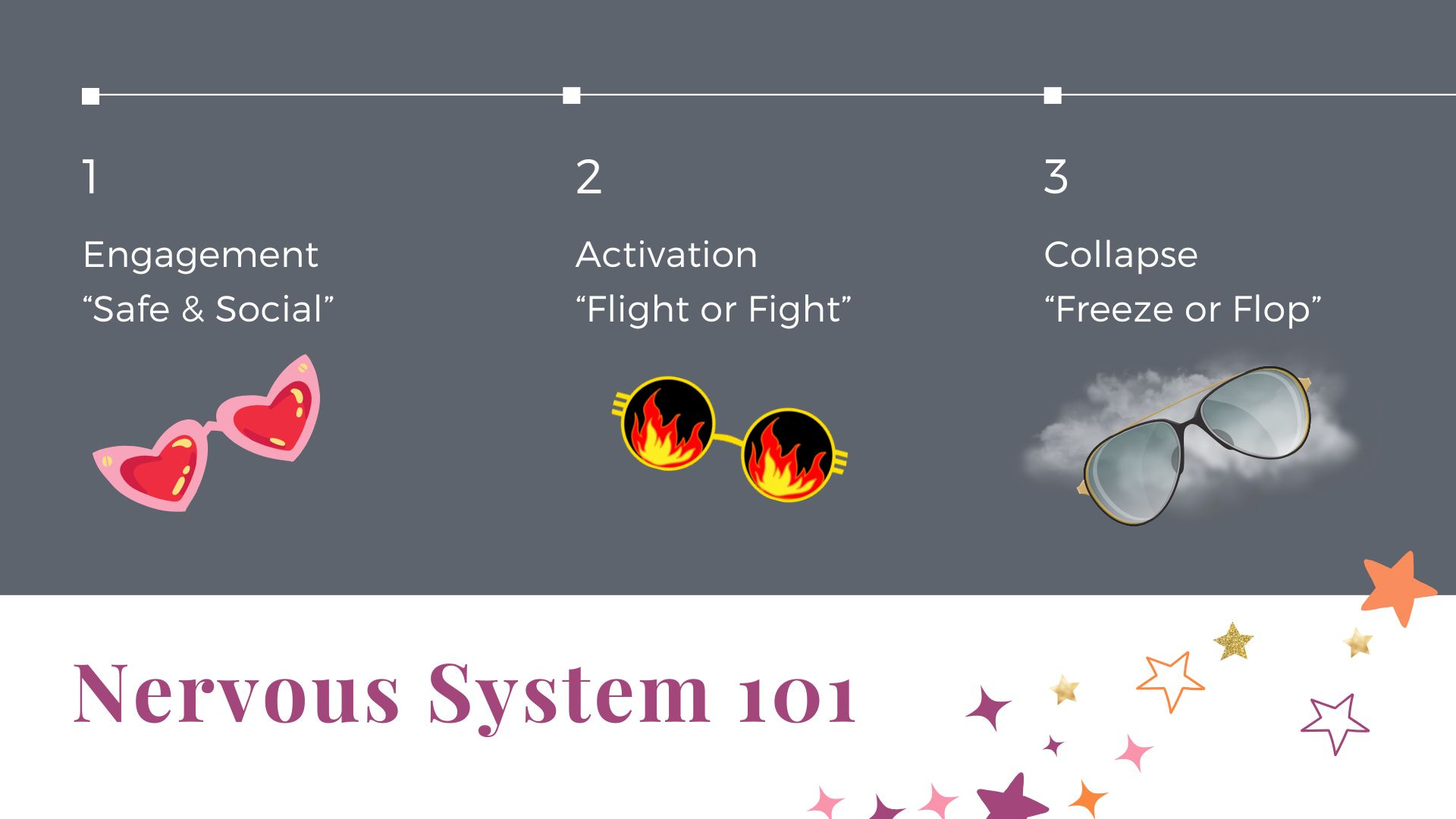
Polyvagal Theory Gave Me a Framework to Understand My Experience
Understanding our nervous systems is a game changer in parenting. The part of our brainstem that keeps us safe (the vagus nerve) communicates with our body in a flash. If you’d like more background, read my 3-part series on Polyvagal-Informed Strategies For a Calmer Family.
As mammals, our vagus nerve has 3 main states:
Safe and social state → when we feel supported and connected
Flight or fight → when our bodies prepare to run or battle the storm
Collapse → when we shut down because it all feels too much
I spent a lot of those early years in collapse. From the outside, I might have looked calm, but inside I felt numb and powerless — like my body had pulled the plug.
Here’s where self-compassion makes such a difference. Each time I paused to soften toward myself — whether by feeling my feet on the ground or whispering something kind — my nervous system got the message:
“You’re safe. You don’t have to fight or flee right now.”
Those tiny moments of compassion weren’t just nice ideas. They were reprogramming my nervous system. They gave me the resilience to keep showing up for Ocean without completely losing myself.

A Kinder Way Forward
Remember that dog with its paw caught in the trap? At first glance, it looked threatening. But once you saw its pain, your heart softened.
Sometimes we’re that dog. Sometimes our kids are. We snarl, snap, or shut down because something inside us hurts. And what we need most in those moments isn’t more judgment. It’s compassion.
Even a small act of kindness toward yourself today (a breath, a pause, a kind word) can begin to loosen the trap and bring relief.
Welcome! Thank you for visiting. I’m Kate, and I’m glad you’re here.
If you’re raising a neurodivergent kid and somewhere along the way you’ve lost touch with yourself…
If you’re longing to be more connected, calm, and present so you can enjoy your family and avoid burnout...
I’d love to walk alongside you.
I hope you’ll subscribe to Self-Regulated Parent. Together, we can create a kinder, more compassionate path forward for ourselves and our kids.
In Part 2, I’ll share how I applied the three pillars of self-compassion to my parenting challenges.
We’ll end with self-kindness practices you can fit into the tiny cracks of your parenting life. Their beautiful simplicity makes them accessible to you during your toughest moments, helping you feel safe and loved.
How Trauma-informed Self Compassion Helps Parents Avoid Burnout

Self-compassion doesn’t erase the hard parts of parenting, but it changes how we live through them.
A kinder future for our kids begins with kindness toward ourselves.
